Category Archives: History

Relating to the historical background and the actual history of photography as a discipline

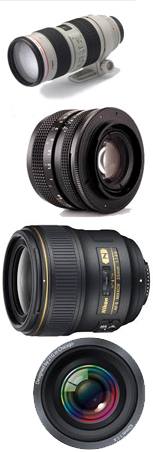
Lenses and designations? Confused? An easy guide

• Lenses •

• Lenses •
Buying lenses optimised for your sensor is confusing.

Lenses are a big investment…

It is difficult to know which lens is optimised for your digital image sensor. There seems to be so many different designations. Here is a guide to which lens designation you want.

Explaining the differences

Brands like Canon and Nikon have their own lenses range. Third party manufacturers, like Sigma, Tokina and Tamron etc. manufacture lenses for brands like Nikon, Canon and others. if buying lenses the third party manufacturers have lenses which are equivalent to the Camera brand manufacturer or possibly better. Look around at online reviews to see what standard of lenses and prices are available.

Make sure you buy lenses fitted with the correct lens mount for your camera. Older models of cameras may have the correct mount but some of the more recent lenses might not be suitable to work with the camera. So check the mount and camera are compatible before buying.

Why are lens mounts specific to brands? It’s mainly historical – the development paths of the manufacturers differ. However, they also want their customers to stay loyal to the brand. This unfortunate situation means you have to reinvest in a new range of lenses if you change your camera body. Hmmm! Expensive.

There are two types of camera sensor. There are cropped sensors – which is a small size. These are more often referred to as APS-C format.

The other sensor format is full frame sensor. These are the size equivalent of the old film SLR frames on a roll of film.

Full frame digital sensors are less common than cropped sensors. The cropped sensors are easier and cheaper to manufacture. However, in recent years we are seeing an increase in full frame releases of new cameras. The higher resolution (more pixels) and potentially bigger print sizes are attractive to consumers. As full frame format gets cheaper they are likely to become more common.

The full frame sensor size is the same size as a 35 mm (36mm ×24mm) film frame in old SLR cameras. Because of the historical significance of the 35mm format modern DSLRs are based on the same standard. Lenses are normally designed to fit either the full frame format or the cropped format.

Lenses designed for the full frame sensor have an image circle that covers the whole 35mm sensor. These lenses tend to be more expensive because they need a wide circle of light thorough them to cover the sensor. They have bigger glass elements as a result.

Full-frame sized lenses are able to fit a camera with the same mount and a cropped sensor. The image circle from the lens remains constant. The smaller sensor size (APS-C) is therefore only able to process the light from the centre of the circle – the rest of the light spills over the side of the sensor. The resultant photograph is like a zoomed-in crop of the image that would have otherwise been taken with a full frame sensor.

This image-cropping effect of smaller sensors is known as the “crop factor”. It represents the ratio of the size of the full-frame 35 mm sensor to the size of the smaller format. The apparent zooming effect also gives rise to an alternative name – the “focal-length multiplier”.

The ratio of full-frame to crop tends to lie in the range 1.3–2.0 for most cropped sensor DSLRs. You might say that a 100 mm lens on a camera with a 1.5 crop factor creates an apparent zoom multiplying the focal length by 1.5. A 100mm lens would then appear to produce the same picture as a 150mm lens. This is not a true magnification since the focal length of the lens is the same on both cameras. Instead the cropped sensor is likely to produce a lower quality result than than the full frame sensor while revealing a closer result.

You can use lenses designed for full frame sensors on cropped sensors. It does not work the other way. A lens designed for a cropped sensor creates an image circle smaller than the full-frame sensor. It would create a circular image with very strong vignetting around the sides. Manufacturers recommend not using lenses designed for cropped sensors on full frame cameras.

Designations

To ensure that buyers purchase the correct lenses for full frame or cropped sensor manufacturers designate them with specific marques. Here is the breakdown of the most common designations for each…

 Manufacturer  Full frame (& APS-C)  APS-C (cropped sensor only)
     Canon                EF           EF-S
     Nikon                FX           DX
     Sigma                DG           DC
     Tokina                FX           DX
     Sony                Various           DT
     Tamron                Di           Di-II
Other related sources…

List of Lens manufacturers (Wikipedia) External link - opens new tab/page
List of List of photographic equipment manufacturers (incl. cameras, lenses etc) (Wikipedia)  External link - opens new tab/page

Comments, additions, amendments or ideas on this article? Contact Us

find out more...Photokonnexion tips by email
If you enjoyed this article please sign up for our
Tips by email service.
                                                 Find out more


By Damon Guy (author and editor)

Netkonnexion

Damon Guy (Netkonnexion)

Damon is managing editor of Photokonnexion.com with professional experience in photography, writing, image libraries, and computing. He is also an experienced, webmaster and a trained teacher. Damon runs regular training for digital photographers who are just starting out.
See also: Editors ‘Bio’
By Damon Guy :: Profile on Google+


Can you write? Of course you can!
Write for Photokonnexion...

We would love to have your articles or tips posted on our site.
Find out more…
Write for Photokonnexion.

Ansel Adams makes his own statement about visualisation

Excellent…

After my visualisation article I came across this video today. Who better to tell us about visualisation than the great man himself. This is Ansel Adams, the great landscape photographer, giving us his interpretation of the visualisation experience. This was apparently a previously unpublished piece. It is just under three minutes long.

Photography Visualization Advice by Ansel Adams

Marc Silber :: Uploaded on 29 Dec 2009

find out more...Photokonnexion tips by email
If you enjoyed this article please sign up for our
Tips by email service.
                                                 Find out more


By Damon Guy (author and editor)

Netkonnexion

Damon Guy (Netkonnexion)

Damon is managing editor of Photokonnexion.com with professional experience in photography, writing, image libraries, and computing. He is also an experienced, webmaster and a trained teacher. Damon runs regular training for digital photographers who are just starting out.
See also: Editors ‘Bio’
By Damon Guy :: Profile on Google+

Seeing what you want to create

• Mushrooms •

• Mushrooms •
Photographers learn many techniques to achieve a particular outcome or ‘look’ in their images. They go beyond reality to create a specific previsualised final image.
Click image to view large
• Mushrooms • By Netkonnexion on Flickr External link - opens new tab/page

Visualise the image you want to make.

Producing a picture can be as simple as point and shoot or as complex as a long planned production. To produce great images you often have to go beyond an elementary snap-capture. The best images are made from a careful thought process. The photographer has a goal in mind, a visualisation of what they want the final image to be.

What is visualisation?

People who use visualisation techniques seek to perform challenging tasks to achieve the visualised goal. The existence of a previsualised goal gives them a clear sense of being able to achieve the goal while trying to achieve it. Users of the technique report they gain an internal boost from having the outcome already in mind.

In sports users of the technique are taught to visualise an explosive use of energy through which they then see themselves complete a record breaking event or win a race. In business the user visualises a goal for their business and continues to enrich the detail and nature of the successful outcome in their mind while working toward attaining it in the real world.

In cinematography whole scenes are previsualised and committed to storyboard form. This creates for the director a clear, detailed mock-up of the scene(s). The storyboards augment and crystalise their mental visualisation of the scene. The latter provides a shared vision for the production team with which to pursue the quality cinematic outcome.

In still photography there has been a long tradition of visualisation. Ansel Adams and several of his contemporaries used the technique. Adams himself defined the use of visualisation as…

…the ability to anticipate a finished image before making an exposure.
Ansel Adams, The Camera, 1980

“.
Adams continued to write about visualisation in photography throughout his life and clearly attributed much of his own success as a photographer to being able to see the finished print in mind before he took the picture.

Adams came to understand the nature of the visualisation through the creation of one of his most important pictures. While working in Yosemite making a picture of the “Half Dome  External link - opens new tab/page” he was using yellow filters to darken the sky. This was a common practice at the time used to simulate in black and white the depth of colour in a sky. However, Adams imagined that the yellow filter would provide an insufficient depth of sky tone to show the drama of the scene before him. Instead he imagined the final print would look better with a darker sky-tone. Applying a red filter instead, he created in the final print the dramatic outcome he had visualised before setting up the camera.

This proved an important moment. He became aware the camera did not simply record a scene. Instead it could be set up to achieve an outcome he had imagined before making the exposure. This visualisation became his guide to the production of the image rather than the absolute reality in the scene.

This realisation enabled Adams to see past the literal and technical capture of the plain camera and lens combination. Instead he was able to create something “expressive” that was a manifestation of the vivid image he had visualised in his imagination.

Today photographers learn many different techniques to achieve a particular outcome or ‘look’ in their images. We see deliberate under or over exposure scenarios created from daylight scenes, or dramatic blood-red sunsets over-saturated to emphasis the power of the retiring sun. The use of visualisation allows the photographer to see in their minds-eye what they want the final image to look like.

Visualisation does not ensure the success of an outcome but it does provide a powerful guide in the process of achieving success. As the photographers visualisations become more detailed and their artistic talents develop so does the visualisation.

Where visualisation is used the technique can only be successful if the appropriate technical steps are deployed. The successful rendering of the visualisation can only come out of a quality photographic process. However, there must also be an interdependence.

Visualisation can be achieved artistically without knowledge of the photographic process. And, the act of visualisation is improved with practice. At the same time, the scene conjured in the minds-eye must also be achievable by the available photographic skills. As skills develop their visualisation skills are more likely to respond to the growing range of techniques the photographer knows. In other words, as a photographers experience grows what is achievable through visualisation also develops. The strength and quality of the visualisation will also be better in areas where the photographer has practised and polished skills.

So, we can reliably infer that visualisation and skill set work together. Landscape photographers will tend to produce better sunset visualisations and images because that is their area of practice and expertise. At the same time fashion photographers will see an outcome for an image that shows off an article of clothing or a delicate facial bone structure because that is how they spend the majority of their time. Each has their specific photographic skill set and technical process. Each photographer also has their own artistic and observational skills that help build expressive visualisations for the type of images they want.

Practice and development

Visualisation is a dynamic and evolving skill. As you become familiar with new techniques your ability to achieve a particular visualisation develops. Visualisation is a skill that develops with awareness of the potential and an ability to imagine a great image before you produce it. The earlier you start to try deliberate visualisation and planning for its fulfilment the more likely you are to take control of your development as a photographer.


By Damon Guy (author and editor)

Netkonnexion

Damon Guy (Netkonnexion)

Damon is managing editor of Photokonnexion.com with professional experience in photography, writing, image libraries, and computing. He is also an experienced, webmaster and a trained teacher. Damon runs regular training for digital photographers who are just starting out.
See also: Editors ‘Bio’
By Damon Guy :: Profile on Google+

find out more...Photokonnexion tips by email
If you enjoyed this article please sign up for our
Tips by email service.
                                                 Find out more

Do you really understand what photography is?

The ramblings of a madman…

Photography is what we do with a camera that records part of the world where we point the lens. Then again, you probably realise that is not true if you have been reading this blog for a while.

The lens does not faithfully record the world – it is always slightly distorted. Numerous technical processes are involved in the translation of a scene into a picture. These all add their own distortions and variations on the original scene. The unique approach taken by the photographer in framing the shot creates its own view of the world which may be different to the next man. All that, and the perceptive filter of the viewer themselves, finally conjures an image beyond the mere recording.

So, what on earth is this thing we call photography? It certainly is not a mere technical record – nor is it a simple interpretation of a scene. Those two roots are important but are not the full story.

I was drawn to address this question, about the nature of photography, this afternoon. I was musing that I had not written a definition of photography in the “Photographic Glossary“. The latter is a collection of articles which have gradually grown since I started this blog. It is now a respectable introduction and background to a wide range of photographic words, phrases, concepts and items of equipment – and I add to it regularly. You can find it on the menu at the top of every page.

Meaning?

Each entry in the glossary needs research to ensure verification of the concepts, vocabulary and application. I think it important I check my facts. In attempting to research “photography” I came across a whole range of explanations which amounted to descriptive statements about:

  • derivation of the words which relate to aspects of photography;
  • the act of photography;
  • processes involved in doing photography;
  • processing in the production of a photograph;
  • history of photography
  • the technical issues;
  • photographic history;
  • postulations about the future of the equipment.

This is all interesting stuff. However, I still found it sterile.

It is important for ‘meaning’ to be attached to feeling. A technical description of the process of photography (film or digital) is interesting but devoid of personal meaning. I am a committed photographer. I love to do photography and I invest a huge part of my life in its pursuit. To me it is not a technical process although I go through a technical process to “do photography”. It is not just the statement about the meaning of a word (see – Definition: photography). Neither is it simply a picture. I am hoping that my picture will stimulate a living, three dimensional mental image in the mind of my viewers.

There is something more to photography than is explained by those sterile descriptions. It’s something which underlies all art, and which is really a step beyond the technical creation of the physical picture. Photography is an attempt by the photographer to communicate with the viewer. Each picture may lie somewhere on the continuum which divides a record of the world and an interpretation of the world. No matter which end of that continuum the picture lies, it speaks to the viewer in a unique way.

My thinking…

I think it sad that I spent several hours this afternoon trying to find real meaning to photography. Yet, through all the technical mumbo-jumbo, the physical processes and even the history not one article made a plain simple statement of commitment to the true depth of what photography means. So here is what I think we mean by photography…

Photography attempts to capture a view of the world with which the photographer communicates their particular meaning and perspective of a scene through a picture, and which if successful, will create a vivid image in the mind of the viewer.
Damon Guy, 09/06/2013

This is sticking my neck out so I expect to be shot down. What does “photography” mean? You tell me.


By Damon Guy (author and editor)

Netkonnexion

Damon Guy (Netkonnexion)

Damon is managing editor of Photokonnexion.com with professional experience in photography, writing, image libraries, and computing. He is also an experienced, webmaster and a trained teacher. Damon runs regular training for digital photographers who are just starting out.
See also: Editors ‘Bio’
By Damon Guy :: Profile on Google+

The art in photography has old roots

Today photography appears more realistic.

Perhaps that is more true than at any time in the history of photography. Yet, today the expression of the artistic element in photography is as alive as the art in say, the history of painting. What is not so clear is just what we mean by “art” in photography.

Much of the modern wave of photography is about snapping the ‘picture’; just capturing what you see and moving on. However, the committed, artistic photographer, sees more in the frame than just the picture. The images we capture show form, shape, expression, balance – lots of intangible things that are not necessarily about just getting the picture and moving on.

Early in the history of photography this very same debate raged. Some saw photography as being “realistic” and therefore not containing artistic elements. Anxious to establish photography as an art form in its own right the Pictorialists worked with the raw elements of the photographic medium, particularly lenses and negatives. They manipulated them to make the picture resemble the hand-made craftiness of paintings and drawings. It was as if taking away the “realistic” look of the final picture and converting it to a facsimile of a hand-drawn picture or a painting turned the picture into an art form.

Perhaps this manipulation did make an art form out of some pictures. However, the basic point was missed by the Pictorialists. The underlying picture still needed an artful arrangement to carry off the translation into a ‘crafty’ final image.

This short video shows the arrival of an alternative school of photographers. The school of “Straight Photography” acknowledged the power of the camera to represent the world with a realism other art forms did not have. At the same time, Straight Photography revealed that through capturing reality you can see through the artists eyes. They went to great pains to retain the element of reality, clarity and sharpness in the pictures. Much of their work would today be recognised as abstract. Their emphasis was on shape, form and expression rather than the every-day and mundane view of the world we see with almost every blink of the eye. They went to great lengths to see things the ordinary picture did not show. They emphasised beauty in simplicity; shape and form in the abstract and a new way of seeing detail through careful framing of everyday objects. They created images that showed the ordinary reality to have an extraordinary interpretation.

Pictorialist and Straight Photography


Debbi Richard


By Damon Guy (author and editor)

Netkonnexion

Damon Guy (Netkonnexion)

Damon is managing editor of Photokonnexion.com with professional experience in photography, writing, image libraries, and computing. He is also an experienced, webmaster and a trained teacher. Damon runs regular training for digital photographers who are just starting out.
See also: Editors ‘Bio’
By Damon Guy :: Profile on Google+


Can you write? Of course you can!
Write for Photokonnexion...

We would love to have your articles or tips posted on our site.
Find out more…
Write for Photokonnexion.

80 year old secret of world class photographers revealed

• Visualisation •

• Visualisation •
Learning to “pre-visualise” your image gives you the edge.

Visualisation – a world-class skill anyone can learn.

Photographers are distinguished from “snappers” by consistently and deliberately making images rather than capturing by good fortune. World-class photographers have a detailed image in their mind before the button is pressed.

Anyone can learn it…

Back in the early 1930′s Ansel Adams, a world-class landscape photographer, applied this technique to his photography. He said that the control of a photograph:

…lies in the selection by the photographer and in his understanding of the photographic processes at his command. The photographer visualizes his conception of the subject as presented in the final print. He achieves the expression of his visualization through his technique – aesthetic, intellectual, and mechanical.
Ansel Adams; “The Studio Annual of Camera Art”, 1934

Adams correspondence of the time showed that others were aware too. Today we all recognise the value of learning to visualise great outcomes for our work, or sports and our future success. So, why not our photography?

Visualisation in photography

What is visualisation? Simple. It is a detailed image in your minds-eye of how you want your final picture to look. A successful picture will recreate the detailed image in your mind as a picture on-screen or print.

Creating the mind-image? It takes a little practice. As we all have images in our heads the trick is to make the image a good one. Once you have an idea for your picture, plan it out – fill out the details. Keep the image in your head by constantly referring to it. You learn to develop that detailed image by learning to observe the outside world. When you look at someone’s hair look at the texture and how the light falls on it. Check the way the shadows fall on their face. Observe sitting positions that flatter their body shape. You see a million details of the world around you every day. Learning to create an image in your head is about visualising those details.

When you see a scene? The “snapper” will point and shoot. The visualising photographer will consider the details. Look at the colour and quality of the light. Understand relationships between light and dark, shadow and brightness. Look at the lines and edges in the scene. Want to raise the impact? Change the scene in your head until you are happy with it. Then, go make the changes. Alternatively, picture the best composition. Exclude the distractions, consider the elements of composition and how you want them to catch the viewers eye in the final photograph. Figure out how you want the depth of field, motion blur, brightness and so on…

Taking the picture… When you have created an exciting image in your minds-eye you have already got your picture. Next create it in-camera. Command the digital processes to recreate what you want for the final image. NOW, and not before, set up your camera. Then take the picture.

Camera control is essential, auto-mode will definitely not recreate what is in your head. What you will find is that as your minds-eye image-making gets better, your technical skills increase to match it. Work at it and images on-screen will flow from images in your mind.

Great pictures

…flow from great images in your mind. If you make a great picture from your visualisation of the scene you will in turn create a great image in the mind of the viewer. The great photographer gets excited and passionate about this translation because it is a unique and powerful communication with the viewer. You can learn this… you just need to see the details in your mind. Practice, and you will make great images.

find out more...Photokonnexion tips by email
If you enjoyed this article please sign up for our
daily email service.
                                                 Find out more


By Damon Guy (author and editor)

Netkonnexion

Damon Guy (Netkonnexion)

Damon is managing editor of Photokonnexion.com with professional experience in photography, writing, image libraries, and computing. He is also an experienced, webmaster and a trained teacher. Damon runs regular training for digital photographers who are just starting out.
See also: Editors ‘Bio’
By Damon Guy :: Profile on Google+


Can you write? Of course you can!
Write for Photokonnexion...

We would love to have your articles or tips posted on our site.
Find out more…
Write for Photokonnexion.

Fantastic street photography insights by the master himself

HenriCartierBresson_TheDecisiveMoment

Henri Cartier-Bresson – (August 22, 1908 – August 3, 2004)
The father of modern street photography and photojournalism

Street photography… like using your eyes as radar.

Cartier-Bresson sought the detail of peoples lives in an instant of time. His legacy lies in understanding the moment of capture – the instant when the power of photography is expressed.

Cartier-Bresson’ insights are so different to the modern photographer. Today we spend endless conversational moments discussing the importance of the latest camera body, the best lens, the latest electronic photo-gizmo… Cartier-Bresson was an early adopter of the old film format 35mm SLR. After World War II he travelled the world, particularly India and the Far East, and saw some of the most momentous political upheavals of our time. The world he saw was raw, harsh and yet vital and dynamic. In those times of upheaval what he saw was not hardship and loss like so much modern photojournalism. He saw vital but ordinary moments in the lives of ordinary people.

The essence of the Cartier-Bresson style was about the “decisive moment”. He saw geometry, pattern and structure through the viewfinder. In doing so he also saw chains of events, micro moments, adding together and creating a moment where the aesthetics and the story were expressed in the shot. In the video (below) he talks about how he knows that moment is the only moment that the photograph would be right.

The power of his insight as a street photographer lies in his ability to see meaning and aesthetics in the moments when he took each shot. He did not spend hours on consideration of his equipment. He spent hours on the philosophy of the “instant” about which each photographic moment was pivotal. He saw into the “seeing of the moment”. It is that moment, if captured just right, that a picture is transformed into an image in the viewers mind. Capture any other moment and the picture remains only a vestige of an unseen event, it does not create the image.

The vitality and sheer energy of his photography and insights is beautifully summed up by this video. It is about the essence of his photography, not about the act of “doing photography”. Modern photographers spend too much time “doing photography” and too little time understanding the implications of what we show our viewers. Cartier-Bresson beautifully sums up his thinking in this video. I have transcribed some of his energy filled comments after the video.

Henri Cartier-Bresson – The Decisive Moment

Oracio Alvarado  External link - opens new tab/page

Some interesting comments transcribed

Some of the comments made by Cartier-Bresson beautifully sum up his thinking. I have edited them a little because the quotes in the video are edits and because his English, although excellent, falters a little in places…

To interest people on far away places… to shock them, to delight them… it’s not too difficult. It’s on your own country – you know too much when its on your own block. It’s such a routine, going to the butcher, er…, it quite difficult… in places I am in all the time, I know too much and not enough. To be lucid about it is most difficult… But your mind must be open. Open-aware. Aware.

(Photography:) It’s like having a search light, a radar… And that’s why to anybody who has done ten good photographs in his life it’s interesting (photography) because its a consistency. Its always re-examining things where you are freer and go deeper.

A camera is a weapon, you can’t prove anything. But at the same time it is a weapon. Not a propaganda means – photography, not at all. But er.. its a way of shouting what you feel.

The camera can be a machine gun… a psycho-analytical couch… it can be a warm kiss… It can be a sketch book, the camera.

…That’s strictly my way of feeling, I enjoy shooting a picture, being present, its like saying “Yes!”, “Yes!”, “Yes!”… Photography is like that, its “Yes!”, “Yes!”, “Yes!”. There’s no maybes. All the maybes should go to the trash. It’s an instant, it’s a presence. Its a moment. It’s there. Its the respect of it, the enjoyment of it. Yes! Its an affirmation. Yes!

Various quotes
Henri Cartier-Bresson
(August 22, 1908 – August 3, 2004)

find out more...Photokonnexion tips by email
If you enjoyed this article please sign up for our
daily email service.
                                                 Find out more


By Damon Guy (author and editor)

Netkonnexion

Damon Guy (Netkonnexion)

Damon is managing editor of Photokonnexion.com with professional experience in photography, writing, image libraries, and computing. He is also an experienced, webmaster and a trained teacher. Damon runs regular training for digital photographers who are just starting out.
See also: Editors ‘Bio’
By Damon Guy :: Profile on Google+